Journal

Ingredient label reference

Dog shampoo ingredient glossary

Look up an ingredient from your dog’s grooming label.

Search 36 ingredients by name or function. A name explains a possible role; it cannot tell you whether the finished product suits your dog.

Find an entry

Search the ingredient name printed on the label (INCI), a common name or an alternative name.

First letter

Showing 36 of 36 entries

Alphabetical by INCI name

Carriers and solvents

Aqua

Water

Also seen as
Water · Eau
Reported functions
Solvent
Example formats
Rinse-off · Leave-on · Wipe
Evidence status
Official function terminology established; a canine finished-product outcome is not established.
View official CosIng function record

Water used as the main liquid carrier in many shampoos, sprays, mousses and lotions.

Why it may be in a product

It dissolves or disperses other ingredients and helps create the intended concentration, flow and application format.

What the name tells you

Its presence usually signals a water-based formula and identifies water using common ingredient terminology.

What the label cannot tell you

It cannot establish percentage, purification quality, microbiological control, preservation, dilution or finished-product safety. The name does not import human-cosmetics label-order rules into pet products.

Discussed in Journal guides

Carriers and solvents

Butylene Glycol

Multifunctional solvent and carrier

Also seen as
1,3-butanediol · Butane-1,3-diol · BG
Reported functions
Humectant · Fragrance · Skin conditioning · Solvent · Viscosity controlling
Example formats
Rinse-off · Leave-on · Wipe · Balm or cream
Evidence status
Official ingredient-function evidence verified current—CosIng marked the record Active on 24 August 2026; it supports the cautious role wording, not a finished-product conclusion.
View official CosIng function record

A multifunctional solvent or carrier that may also influence moisture retention, feel and viscosity.

Why it may be in a product

It can help dissolve or distribute compatible ingredients while contributing to the flow and application feel of a formula.

What the name tells you

It identifies Butylene Glycol and points to possible solvent, humectant, conditioning or viscosity roles.

What the label cannot tell you

It cannot establish concentration, precise grade, which ingredients it carries, its dominant function, sensory result or formula performance.

Thickeners and rheology modifiers

Carbomer

Gel-forming polymer

Also seen as
Crosslinked polyacrylic acid · Poly(acrylic acid) crosspolymer · Carboxypolymethylene
Reported functions
Emulsion stabilising · Gel forming · Viscosity controlling
Example formats
Rinse-off · Leave-on · Wipe · Balm or cream
Evidence status
Official ingredient-function evidence verified current—CosIng marked the record Active on 24 August 2026; it supports the cautious role wording, not a finished-product conclusion.
View official CosIng function record

A polymer used to form gels, thicken liquid formulas and help emulsions resist separation.

Why it may be in a product

It can turn a thin liquid into a controlled gel or add structure to a wash, leave-on, wipe liquid or cream.

What the name tells you

It identifies carbomer and points to a possible gel-structure, viscosity or emulsion-stability role.

What the label cannot tell you

It cannot establish polymer grade, percentage, neutralisation, finished pH, measured viscosity or a stability-test result.

Occlusives and film-forming ingredients

Cera Alba

White beeswax

Also seen as
Beeswax · White beeswax
Reported functions
Film forming · Skin conditioning—emollient · Emulsifying · Perfuming
Example formats
Balm or cream
Evidence status
Official function terminology established; a canine finished-product outcome is not established.
View official CosIng function record

A structured wax used to form a surface film and give balms or sticks body and hold.

Why it may be in a product

It can influence firmness, application and the film left by a balm, while also contributing to the structure of an emulsion.

What the name tells you

It identifies a wax with reported film-forming, emollient, emulsifying and perfuming functions.

What the label cannot tell you

It cannot establish wax quality, processing, amount, final occlusivity, stiffness, lick exposure, allergy suitability or product safety. Film forming is not proof of a clinical barrier benefit.

Emollients

Cetearyl Alcohol

Waxy fatty-alcohol blend

Also seen as
Cetostearyl alcohol · Cetylstearyl alcohol · Fatty alcohol
Reported functions
Skin conditioning—emollient · Emulsifying · Emulsion stabilising · Viscosity controlling · Opacifying
Example formats
Rinse-off · Leave-on · Balm or cream
Evidence status
Official function terminology established; a canine finished-product outcome is not established.
View official CosIng function record

A waxy fatty-alcohol blend used to soften feel, add body and help stabilise emulsions. It is not the same ingredient class as ethanol.

Why it may be in a product

It can build a cream or conditioner structure and change richness, spread and after-feel.

What the name tells you

It identifies an ingredient with reported emollient, emulsifying and texture-supporting functions.

What the label cannot tell you

It cannot establish the cetyl-to-stearyl ratio, source, amount, emulsion stability, richness, mildness or tolerance.

Fragrance, colour and sensory modifiers

CI 42090

Blue colour-index ingredient

Also seen as
Acid Blue 9 · Brilliant Blue FCF · Blue 1 · FD&C Blue No. 1
Reported functions
Colorant · Hair dyeing
Example formats
Rinse-off · Leave-on · Wipe · Balm or cream
Evidence status
Official ingredient-function evidence verified current—CosIng marked the record Active on 24 August 2026; it supports the cautious role wording, not a finished-product conclusion.
View official CosIng function record

A triphenylmethane colourant used to impart or adjust blue colour.

Why it may be in a product

It can give a formula a recognisable colour or help a manufacturer keep its visible appearance consistent.

What the name tells you

It identifies the colour-index ingredient CI 42090 and its reported colourant and hair-dyeing functions.

What the label cannot tell you

It cannot establish concentration, exact salt or lake form, intended shade, colour intensity, finished-product compliance or suitability.

Related entries

pH adjusters and buffers

Citric Acid

Citric acid

Read the full Citric Acid ingredient page →
Also seen as
2-hydroxypropane-1,2,3-tricarboxylic acid · E330
Reported functions
Buffering · Chelating · Fragrance
Example formats
Rinse-off · Leave-on · Wipe
Evidence status
Official function terminology established; a canine finished-product outcome is not established.
View official CosIng function record

An organic acid used as part of a buffering or pH-adjustment system and sometimes to bind metal ions.

Why it may be in a product

A formulator may use it in a small amount to tune the finished system rather than as a headline ingredient.

What the name tells you

Its presence suggests pH, buffering or chelation work may be part of the formula design.

What the label cannot tell you

It cannot establish amount, reason for use, finished pH, acidity, a ‘pH balanced’ claim, mildness or canine skin compatibility. E330 is only a food-code search alias, not grade equivalence.

Discussed in Journal guides

Cleansing agents and surfactants

Cocamidopropyl Betaine

Amphoteric surfactant

Read the full Cocamidopropyl Betaine ingredient page →
Also seen as
CAPB · Cocamidopropyl betaine
Reported functions
Cleansing · Surfactant—cleansing · Surfactant—foam boosting · Hair conditioning · Viscosity controlling · Antistatic
Example formats
Rinse-off · Leave-on
Evidence status
Official function terminology established; a canine finished-product outcome is not established.
View official CosIng function record

A surface-active ingredient used to help loosen and suspend oily soil, support foam and tune the feel or thickness of a wash.

Why it may be in a product

It may form one part of a blended cleansing system, where several surfactants shape foam, rinse and after-feel together.

What the name tells you

It identifies one multifunctional component that may contribute to cleansing, foam, conditioning or viscosity.

What the label cannot tell you

It cannot establish amount, raw-material composition or purity, cleansing strength, mildness, sensitisation potential or finished-product tolerance.

Discussed in Journal guides

Cleansing agents and surfactants

Decyl Glucoside

Glucose-derived surfactant

Read the full Decyl Glucoside ingredient page →
Also seen as
Decyl D-glucoside · Decyl polyglucoside · C10 alkyl glucoside · Alkyl polyglucoside
Reported functions
Cleansing · Emulsion stabilising · Surfactant—cleansing
Example formats
Rinse-off · Wipe
Evidence status
CosIng-supported identity and function vocabulary; canine-specific performance and finished-formula evidence are not established.
View official CosIng function record

A glucose-derived surface-active ingredient used to help lift and disperse soil and support the uniformity of some emulsions.

Why it may be in a product

It may be combined with other surfactants to shape cleansing, rinse and after-feel while also supporting the formula's physical structure.

What the name tells you

It identifies decyl glucoside and points to a cleansing or emulsion-support role in the formula.

What the label cannot tell you

It cannot establish exact amount, chain-length or composition distribution, grade, the rest of the surfactant blend, cleansing power, mildness, final stability or canine suitability. Alkyl polyglucoside is a broader class search term.

Discussed in Journal guides

Occlusives and film-forming ingredients

Dimethicone

Silicone conditioning fluid

Read the full Dimethicone ingredient page →
Also seen as
Dimeticone · Dimeticonum · Polydimethylsiloxane · PDMS
Reported functions
Skin conditioning—emollient · Skin conditioning · Skin protecting
Example formats
Leave-on · Wipe · Balm or cream
Evidence status
Official ingredient-function evidence verified current—CosIng marked the record Active on 24 August 2026; it supports the cautious role wording, not a finished-product conclusion.
View official CosIng function record

Carriers and solvents

Dipropylene Glycol

Multifunctional solvent and carrier

Also seen as
DPG · Oxydipropanol · Dipropylene glycol mixed isomers
Reported functions
Fragrance · Solvent · Viscosity controlling · Perfuming
Example formats
Rinse-off · Leave-on · Wipe · Balm or cream
Evidence status
Active CosIng record verified on 24 August 2026; function names are official terminology, while role and format examples are cautious editorial interpretation.
View official CosIng function record

A multifunctional solvent or carrier that may help dissolve and distribute formula components and influence viscosity; CosIng also lists fragrance and perfuming functions.

Why it may be in a product

It can carry compatible scent or formula materials and help tune their distribution and the formula's flow.

What the name tells you

It identifies Dipropylene Glycol and its reported solvent, viscosity, fragrance and perfuming functions.

What the label cannot tell you

It cannot establish concentration, isomer distribution or grade, what it carries, its primary purpose, scent contribution or finished-formula performance.

Chelators and antioxidants

Disodium EDTA

Chelating agent

Read the full Disodium EDTA ingredient page →
Also seen as
Disodium edetate · Disodium ethylenediaminetetraacetate
Reported functions
Chelating · Viscosity controlling
Example formats
Rinse-off · Leave-on · Wipe
Evidence status
Official function terminology established; a canine finished-product outcome is not established.
View official CosIng function record

A chelator used to bind certain metal ions that could otherwise affect colour, odour, stability or parts of a preservation system.

Why it may be in a product

It can support overall formula stability and work alongside, rather than replace, an appropriate preservation system.

What the name tells you

Its presence identifies a supporting formulation role that may not be obvious from front-label claims.

What the label cannot tell you

It cannot establish concentration, metals present or bound, preservation boost, final stability, environmental profile or product safety.

Discussed in Journal guides

Humectants

Glycerin

Glycerol

Read the full Glycerin ingredient page →
Also seen as
Glycerol · Glycerine · Vegetable glycerin
Reported functions
Humectant · Skin conditioning—humectant · Solvent
Example formats
Rinse-off · Leave-on · Wipe · Balm or cream
Evidence status
Function terminology established; limited canine finished-formula evidence does not isolate glycerin's effect.
View official CosIng function record

A water-binding ingredient used to manage moisture in a formula and, in an appropriately designed leave-on, help support surface hydration.

Why it may be in a product

It can influence water retention, spread and feel as one part of a wider moisturising system.

What the name tells you

It identifies a familiar humectant, skin-conditioning and solvent ingredient in the formula.

What the label cannot tell you

It cannot establish origin, concentration, tack, water activity, hydration result, preservation or suitability. ‘Vegetable glycerin’ is equivalent only when source is separately documented.

Discussed in Journal guides

Conditioning and antistatic agents

Guar Hydroxypropyltrimonium Chloride

Cationic guar conditioner

Also seen as
Cationic guar · Guar gum hydroxypropyltrimonium chloride
Reported functions
Antistatic · Film forming · Skin conditioning · Viscosity controlling
Example formats
Rinse-off · Leave-on
Evidence status
Function terminology established; mechanistic hair evidence is indirect and not a canine-product result.
View official CosIng function record

A positively charged guar derivative that can deposit on hair, form a light film and help reduce static or improve conditioned feel.

Why it may be in a product

It can balance the feel of a shampoo, conditioner or combined format and support slip after cleansing.

What the name tells you

Its presence points to a deliberate conditioning, antistatic, film-forming or viscosity role.

What the label cannot tell you

It cannot establish molecular weight, charge density, deposition, combability benefit, amount or canine-coat performance.

Discussed in Journal guides

Thickeners and rheology modifiers

Hydroxyethylcellulose

Cellulose-derived thickener

Also seen as
HEC · Hydroxyethyl cellulose · Cellulose 2-hydroxyethyl ether · Hyetellose
Reported functions
Emulsion stabilising · Viscosity controlling · Film forming
Example formats
Rinse-off · Leave-on · Wipe · Balm or cream
Evidence status
Official ingredient-function evidence verified current—CosIng marked the record Active on 24 August 2026; it supports the cautious role wording, not a finished-product conclusion.
View official CosIng function record

A cellulose-derived polymer that thickens water-based formulas, supports emulsion stability and may leave a light film.

Why it may be in a product

It can add body and controlled flow to several formats while helping keep the formula uniform.

What the name tells you

It identifies a viscosity-control, emulsion-stabilising and film-forming ingredient.

What the label cannot tell you

It cannot establish grade, molecular weight, percentage, hydration method or the finished product's exact thickness and feel.

Related entries

Emollients

Isopropyl Myristate

Lightweight emollient ester

Also seen as
IPM · Isopropyl tetradecanoate · Propan-2-yl tetradecanoate · Isopropyl ester of myristic acid
Reported functions
Binding · Skin conditioning—emollient · Fragrance · Perfuming
Example formats
Rinse-off · Leave-on · Balm or cream
Evidence status
CosIng supports emollient and related formulation functions; canine and finished-formula performance are not established.
View official CosIng function record

A lightweight ester used to improve spread and add slip or softness to the surface feel of a formula.

Why it may be in a product

It can help an oil-rich product spread more readily and change the perceived greasiness or finish during application.

What the name tells you

It identifies an emollient ester that may contribute to spread, binding or surface feel.

What the label cannot tell you

It cannot establish source, grade, concentration, absorption, greasiness, finished emolliency, fragrance contribution, tolerance, safety or canine suitability.

Fragrance, colour and sensory modifiers

Linalool

Perfuming scent material

Read the full Linalool ingredient page →
Also seen as
Linalyl alcohol · 3,7-dimethyl-1,6-octadien-3-ol · 1,6-octadien-3-ol, 3,7-dimethyl-
Reported functions
Deodorant · Perfuming
Example formats
Rinse-off · Leave-on · Wipe · Balm or cream
Evidence status
Official ingredient-function evidence verified current—CosIng marked the record Active on 24 August 2026; it supports the cautious role wording, not a finished-product conclusion.
View official CosIng function record

A scent material used for perfuming; CosIng also lists a deodorant function.

Why it may be in a product

It can contribute a specific scent note or arrive as one disclosed component of a wider fragrance material.

What the name tells you

It identifies Linalool and its reported perfuming and deodorant functions.

What the label cannot tell you

It cannot establish concentration, source, whether it was added alone or arrived through another material, the finished scent or product suitability.

Discussed in Journal guides

Fragrance, colour and sensory modifiers

Parfum

Fragrance composition

Read the full Parfum ingredient page →
Also seen as
Fragrance · Perfume · Aroma
Reported functions
Fragrance · Perfuming
Example formats
Rinse-off · Leave-on · Wipe · Balm or cream
Evidence status
Official function terminology established; a canine finished-product outcome is not established.
View official CosIng function record

A labelling term indicating a material or blend added to create or mask odour.

Why it may be in a product

Fragrance shapes the human experience of grooming and the perceived character of the finished product.

What the name tells you

It tells you that a fragrance material or blend is listed; the term is intentionally non-specific.

What the label cannot tell you

It cannot establish individual materials, concentration, source or naturalness, allergen-disclosure duties, persistence, tolerability or safety. Aroma is a search aid, not necessarily an exact synonym in every product.

Discussed in Journal guides

Emulsifiers and solubilizers

PEG-40 Hydrogenated Castor Oil

Non-ionic emulsifying surfactant

Also seen as
PEG-40 HCO · Polyoxyethylene (40) hydrogenated castor oil · Hydrogenated castor oil ethoxylate · PEG-40 castor-oil derivative
Reported functions
Surfactant—emulsifying · Surfactant—cleansing
Example formats
Rinse-off · Leave-on · Wipe
Evidence status
Official ingredient-function evidence verified current—CosIng marked the record Active on 24 August 2026; it supports the cautious role wording, not a finished-product conclusion.
View official CosIng function record

A non-ionic surfactant used to help oil-based materials disperse more evenly through a water-based formula.

Why it may be in a product

It can help distribute fragrance or other oil-compatible materials in a wash, spray or wipe liquid.

What the name tells you

It identifies PEG-40 Hydrogenated Castor Oil and points to recognised emulsifying and cleansing surfactant functions.

What the label cannot tell you

It cannot establish percentage, supplier grade, which material it disperses or the finished formula's clarity, feel and stability.

Preservatives and product-protection systems

Phenoxyethanol

Preservative ingredient

Read the full Phenoxyethanol ingredient page →
Also seen as
2-phenoxyethanol · Phenoxyethyl alcohol · Ethylene glycol monophenyl ether · Phenoxyethanolum
Reported functions
Antimicrobial · Preservative
Example formats
Rinse-off · Leave-on · Wipe · Balm or cream
Evidence status
Official ingredient-function evidence verified current—CosIng marked the record Active on 24 August 2026; it supports the cautious role wording, not a finished-product conclusion.
View official CosIng function record

A preservative used to help limit microbial growth in the formula as part of its product-protection system.

Why it may be in a product

It can contribute to the wider preservation strategy needed for a formula during manufacture, storage and intended use.

What the name tells you

It identifies phenoxyethanol and its recognised antimicrobial and preservative functions for protecting the formula.

What the label cannot tell you

It cannot establish concentration, combination with other preservatives, manufacturing hygiene, challenge-test result or overall preservation adequacy.

Conditioning and antistatic agents

Polyquaternium-10

Cationic cellulose polymer

Also seen as
Polyquaternium 10 · PQ-10 · Cationic hydroxyethylcellulose · Quaternised hydroxyethylcellulose
Reported functions
Antistatic · Film forming
Example formats
Rinse-off · Leave-on
Evidence status
CosIng supports antistatic and film-forming functions; canine-coat and finished-product evidence are not established.
View official CosIng function record

A positively charged cellulose-derived polymer used to leave a light film and help reduce static on hair.

Why it may be in a product

It can add a conditioning element to a shampoo or leave-on and influence the feel left after application or rinsing.

What the name tells you

It identifies a cationic film-forming, antistatic polymer in the formula.

What the label cannot tell you

It cannot establish polymer grade, molecular weight, charge density, concentration, deposition, combability, residue or performance on canine coat.

Conditioning and antistatic agents

Polyquaternium-7

Cationic conditioning copolymer

Also seen as
Polyquaternium 7 · PQ-7 · Acrylamide/diallyldimethylammonium chloride copolymer · Dimethyldiallylammonium chloride/acrylamide copolymer
Reported functions
Antistatic · Film forming
Example formats
Rinse-off · Leave-on
Evidence status
CosIng supports identity and function in human-cosmetics context; canine-coat and finished-product evidence are not established.
View official CosIng function record

A cationic copolymer used to form a light film and help limit static on hair.

Why it may be in a product

It may be included to balance after-feel in a cleansing system or add a conditioning film to a leave-on format.

What the name tells you

It identifies an antistatic, film-forming polymer in the formula.

What the label cannot tell you

It cannot establish polymer specification, concentration, deposition, film thickness, static reduction, combability, residue, regulatory compliance of the finished pet product or canine suitability.

Emulsifiers and solubilizers

Polysorbate 20

Non-ionic emulsifying surfactant

Also seen as
Polyoxyethylene (20) sorbitan monolaurate · Tween 20
Reported functions
Surfactant—emulsifying · Surfactant—cleansing
Example formats
Rinse-off · Leave-on · Wipe
Evidence status
Official function terminology established; a canine finished-product outcome is not established.
View official CosIng function record

A non-ionic surfactant used to help disperse small amounts of oily or fragrance material through a water-based formula.

Why it may be in a product

It may help a spray, wash or lotion keep otherwise incompatible materials distributed through the formula.

What the name tells you

Its presence points to an emulsifying or cleansing role; ‘solubilizer’ is useful formulation language rather than the exact database tag.

What the label cannot tell you

It cannot establish what it disperses, the required ratio, amount, oxidation or impurity profile, clarity, stability, cleansing power or tolerance. Tween 20 is not an identity guarantee.

Emulsifiers and solubilizers

Polysorbate 80

Non-ionic emulsifying surfactant

Also seen as
Polysorbatum 80 · Polyoxyethylene (20) sorbitan monooleate · Sorbitan monooleate ethoxylate · PS80
Reported functions
Surfactant—emulsifying
Example formats
Rinse-off · Leave-on · Wipe
Evidence status
Official ingredient-function evidence verified current—CosIng marked the record Active on 24 August 2026; it supports the cautious role wording, not a finished-product conclusion.
View official CosIng function record

A non-ionic surfactant used to help oily materials disperse through a water-based formula.

Why it may be in a product

It can help keep an oil-compatible material distributed through a wash, leave-on or wipe liquid.

What the name tells you

It identifies Polysorbate 80 and its recognised emulsifying function.

What the label cannot tell you

It cannot establish percentage, grade, which material it disperses, droplet size or the finished formula's stability.

Preservatives and product-protection systems

Potassium Sorbate

Preservative ingredient

Also seen as
Sorbic acid potassium salt · Potassium (E,E)-hexa-2,4-dienoate · Kalii sorbas · E202
Reported functions
Preservative
Example formats
Rinse-off · Leave-on · Wipe · Balm or cream
Evidence status
Official ingredient-function evidence verified current—CosIng marked the record Active on 24 August 2026; it supports the cautious role wording, not a finished-product conclusion.
View official CosIng function record

A preservative used as one part of a formula's product-protection system.

Why it may be in a product

It may contribute to a broader preservation strategy designed around the full formula and its conditions of use.

What the name tells you

It identifies Potassium Sorbate and its recognised preservative function for protecting the formula.

What the label cannot tell you

It cannot establish percentage, finished-product pH, other preservation measures, challenge-test results or overall preservation adequacy. E202 is only a food-code search alias.

Humectants

Propylene Glycol

Water-miscible humectant and solvent

Read the full Propylene Glycol ingredient page →
Also seen as
1,2-propanediol · Propane-1,2-diol · PG
Reported functions
Humectant · Skin conditioning—humectant · Solvent · Viscosity controlling · Fragrance
Example formats
Rinse-off · Leave-on · Wipe · Balm or cream
Evidence status
CosIng-supported function vocabulary; ingredient presence alone provides no canine or finished-formula outcome evidence.
View official CosIng function record

A small water-miscible ingredient used to hold water, carry dissolved materials and help tune formula flow.

Why it may be in a product

It can combine humectant and solvent roles in one ingredient and help distribute other water-compatible materials through a formula.

What the name tells you

It identifies propylene glycol and points to a possible humectant, solvent or viscosity role.

What the label cannot tell you

It cannot establish source, grade, exact amount, water activity, hydration result, tack, preservation, irritation potential, safety or individual-dog suitability.

Related entries

Occlusives and film-forming ingredients

PVP

Water-soluble film-forming polymer

Also seen as
Polyvinylpyrrolidone · Povidone · Povidonum · PVP polymer
Reported functions
Binding · Emulsion stabilising · Film forming · Viscosity controlling
Example formats
Rinse-off · Leave-on · Wipe
Evidence status
Official ingredient-function evidence verified current—CosIng marked the record Active on 24 August 2026; it supports the cautious role wording, not a finished-product conclusion.
View official CosIng function record

A water-soluble polymer that can dry into a light film, bind formula components and add body.

Why it may be in a product

It can influence hold, deposition or structure in a formula while supporting viscosity or emulsion stability.

What the name tells you

It identifies PVP and points to film-forming, binding, stabilising and viscosity-control functions.

What the label cannot tell you

It cannot establish molecular weight, percentage, film strength, stiffness, wash-off behaviour or the final sensory result.

Preservatives and product-protection systems

Sodium Benzoate

Preservative ingredient

Read the full Sodium Benzoate ingredient page →
Also seen as
Sodium salt of benzoic acid · E211
Reported functions
Preservative · Anticorrosive · Fragrance
Example formats
Rinse-off · Leave-on · Wipe
Evidence status
Official function terminology established; a canine finished-product outcome is not established.
View official CosIng function record

A preservative used under suitable formula conditions to help protect the product from microbial spoilage.

Why it may be in a product

Water-containing products need a validated preservation strategy; one named preservative is only part of that system.

What the name tells you

It identifies an ingredient reported to protect a formula from microorganisms—not to disinfect a dog.

What the label cannot tell you

It cannot establish concentration, finished pH, organisms controlled, the complete preservation system, challenge-test result, shelf life or canine safety. E211 is only a food-code search alias.

Discussed in Journal guides

pH adjusters and buffers

Sodium Citrate

Citrate buffer and chelator

Also seen as
Trisodium citrate · Citric acid trisodium salt · Sodium citrate salt
Reported functions
Buffering · Chelating · Fragrance
Example formats
Rinse-off · Leave-on · Wipe · Balm or cream
Evidence status
Official ingredient-function evidence verified current—CosIng marked the record Active on 24 August 2026; it supports the cautious role wording, not a finished-product conclusion.
View official CosIng function record

A citrate salt that may contribute to buffering and metal-ion binding; CosIng also lists a fragrance function.

Why it may be in a product

It can support a formula's pH-control system and bind certain metal ions as one part of the wider design.

What the name tells you

It identifies Sodium Citrate and points to possible buffering, chelating or fragrance roles.

What the label cannot tell you

It cannot establish concentration, finished pH, buffering capacity, chelation contribution, source or formula performance.

Discussed in Journal guides

pH adjusters and buffers

Sodium Hydroxide

Alkaline pH-adjustment input

Also seen as
Caustic soda · Lye · Sodium hydrate
Reported functions
Buffering · Denaturant
Example formats
Rinse-off · Leave-on · Wipe · Balm or cream
Evidence status
Official ingredient-function evidence verified current—CosIng marked the record Active on 24 August 2026; it supports the cautious role wording, not a finished-product conclusion.
View official CosIng function record

An alkaline formulation input that may be used in controlled amounts to adjust or buffer pH.

Why it may be in a product

It can be part of the manufacturing adjustment that brings a complete formula toward its intended finished pH.

What the name tells you

It identifies Sodium Hydroxide and its reported buffering and denaturant functions.

What the label cannot tell you

It cannot establish finished-product pH, concentration, residual amount, why it was used or finished-product suitability or compliance.

Discussed in Journal guides

Cleansing agents and surfactants

Sodium Laureth Sulfate

Anionic cleansing surfactant

Read the full Sodium Laureth Sulfate ingredient page →
Also seen as
SLES · Sodium lauryl ether sulfate · Sodium laureth sulphate · Sodium lauryl ether sulphate
Reported functions
Cleansing · Surfactant—emulsifying · Foaming · Surfactant—cleansing
Example formats
Rinse-off
Evidence status
CosIng-supported identity and function vocabulary; canine-specific performance and finished-formula evidence are not established.
View official CosIng function record

An anionic surface-active ingredient used to help lift and disperse oily soil and to build foam in a cleansing formula.

Why it may be in a product

It can form part of a blended cleansing base where foam, soil removal, rinse and after-feel are adjusted together.

What the name tells you

It identifies the named surfactant and points to a possible cleansing, foam or emulsifying contribution.

What the label cannot tell you

It cannot establish exact amount, material or CAS specification, degree of ethoxylation, the rest of the surfactant blend, finished pH, cleansing strength, mildness or canine suitability.

Discussed in Journal guides

Humectants

Sodium PCA

Water-binding conditioning salt

Also seen as
Sodium pyrrolidone carboxylate · Sodium 2-pyrrolidone-5-carboxylate · Sodium pyroglutamate · Na-PCA
Reported functions
Antistatic · Hair conditioning · Humectant · Skin conditioning
Example formats
Rinse-off · Leave-on · Wipe · Balm or cream
Evidence status
CosIng supports the listed formulation functions; canine-specific and finished-product evidence are not established.
View official CosIng function record

A water-binding salt used to help manage moisture and contribute to a conditioned surface feel.

Why it may be in a product

It can add humectant and conditioning functions to a water-based wash, leave-on, wipe or cream.

What the name tells you

It identifies a humectant with reported conditioning and antistatic functions.

What the label cannot tell you

It cannot establish grade, concentration, retained moisture, deposition, coat feel, formula performance, safety or suitability for an individual dog.

Discussed in Journal guides

Chelators and antioxidants

Sodium Phytate

Chelating phytate salt

Also seen as
Phytic acid sodium salt · Sodium salt of phytic acid · Sodium inositol hexaphosphate
Reported functions
Chelating · Oral care
Example formats
Rinse-off · Leave-on · Wipe · Balm or cream
Evidence status
Official ingredient-function evidence verified current—CosIng marked the record Active on 24 August 2026; it supports the cautious role wording, not a finished-product conclusion.
View official CosIng function record

A chelator that may bind available metal ions within a formula.

Why it may be in a product

It can support formula appearance or stability where trace metal ions might otherwise interfere with the system.

What the name tells you

It identifies Sodium Phytate and its reported chelating and oral-care functions.

What the label cannot tell you

It cannot establish concentration, source or grade, intended function, metal-binding contribution or finished-formula performance.

Emollients

Squalane

Stable hydrocarbon emollient

Also seen as
Hydrogenated squalene · Perhydrosqualene · Squalane oil · Squalan
Reported functions
Skin conditioning—emollient · Hair conditioning · Refatting · Skin conditioning
Example formats
Leave-on · Balm or cream
Evidence status
CosIng supports the listed human-cosmetics formulation functions; canine-specific and finished-product evidence are not established.
View official CosIng function record

A stable hydrocarbon emollient used to add slip, soften surface feel and replenish an oily feel in a formula.

Why it may be in a product

It can change spread and finish in a leave-on, balm or cream and contribute to a richer conditioning phase.

What the name tells you

It identifies squalane and points to possible emollient, conditioning or refatting roles.

What the label cannot tell you

It cannot establish feedstock or source, purity, grade, concentration, spread, residue, coat or skin outcome, safety or canine suitability. Squalane oil is a retail search term, not a grade guarantee.

Discussed in Journal guides

Chelators and antioxidants

Tocopherol

Vitamin E antioxidant ingredient

Also seen as
Tocopherols · Vitamin E · Mixed tocopherols · Alpha-tocopherol
Reported functions
Antioxidant · Fragrance · Skin conditioning—miscellaneous · Skin conditioning—occlusive
Example formats
Rinse-off · Leave-on · Balm or cream
Evidence status
Official ingredient-function evidence verified current—CosIng marked the record Active on 24 August 2026; it supports the cautious role wording, not a finished-product conclusion.
View official CosIng function record

An antioxidant ingredient that may help limit oxidation of oxidation-prone formula components; CosIng also lists fragrance and skin-conditioning functions.

Why it may be in a product

It can contribute to an oil-phase antioxidant strategy while also influencing the formula's conditioning profile.

What the name tells you

It identifies Tocopherol and its reported antioxidant, fragrance and skin-conditioning functions.

What the label cannot tell you

It cannot establish concentration, isomer mixture, source, intended function, oxidation control or finished-formula performance. Vitamin E and mixed tocopherols are search aids, not grade guarantees.

Thickeners and rheology modifiers

Xanthan Gum

Xanthan gum

Also seen as
Xanthan · E415
Reported functions
Binding · Gel forming · Emulsion stabilising · Viscosity controlling · Skin conditioning
Example formats
Rinse-off · Leave-on · Wipe · Balm or cream
Evidence status
Official function terminology established; a canine finished-product outcome is not established.
View official CosIng function record

A polysaccharide used to thicken water-based formulas, form gels and help keep an emulsion or suspension uniform.

Why it may be in a product

It can help a formula remain uniform, stay where applied and dispense with a controlled flow.

What the name tells you

Its presence points to texture or stability work, although the ingredient has several reported supporting functions.

What the label cannot tell you

It cannot establish grade, amount, final viscosity or flow, sprayability, sensory feel, stability or microbial preservation. E415 is only a food-code search alias.

Discussed in Journal guides

What this tool does

  • translates ingredient names into formulation roles
  • connects aliases to one stable reference entry
  • gives every entry a link that can be cited or shared

What this tool does not do

  • score ingredients as good, bad, safe or unsafe
  • diagnose, treat or prevent a canine condition
  • prove finished-product quality from one label name
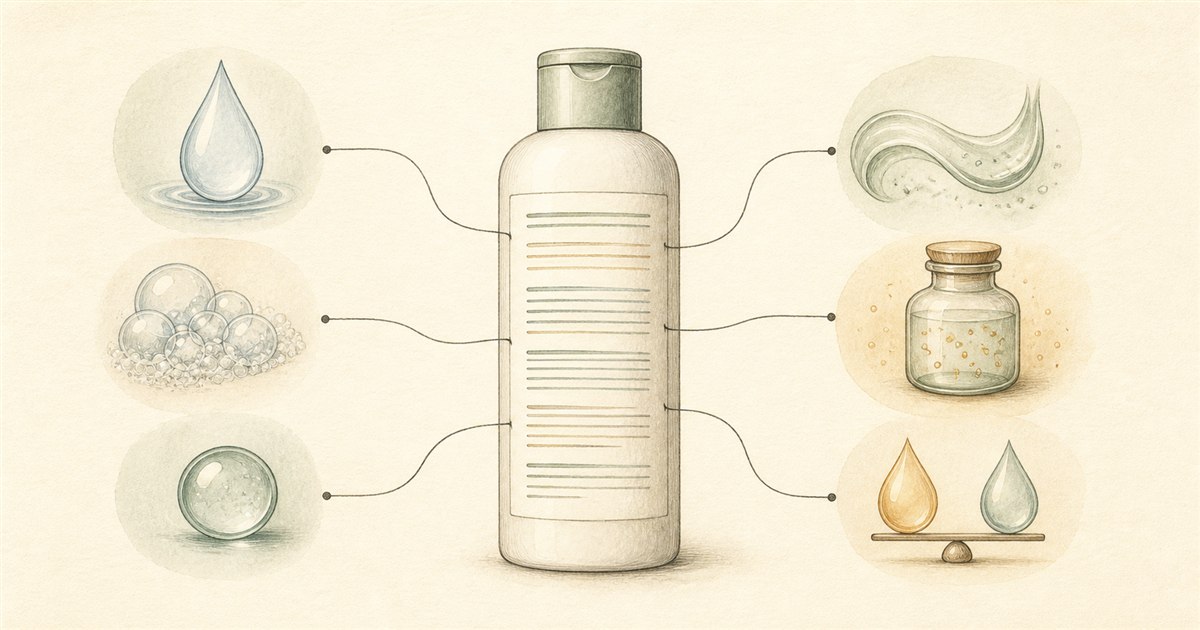
Conceptual dog shampoo bottle with an abstract ingredient list connected to six equal formulation-role illustrations.
AI-assisted concept illustration of a fictional label mapped to carrier, cleansing, moisture-related, texture, product-protection and pH-related roles. It is not a real formula, safety score, efficacy claim or statement of concentration.

Evidence and boundaries

Terminology sources, shown plainly.

The glossary uses official European sources to check ingredient terminology and to keep medical, biocidal and finished-product claims outside the glossary. Cosmetic references concern human products; their use here is limited to names and reported formulation functions.

Reference review: 2026-08-25.

Read the Journal editorial method →
  1. Source 1

    European Commission — CosIng database

    A non-binding reference for cosmetic ingredient names and reported functions. It concerns human cosmetics and is used here only as a terminology source, not as canine safety approval.

  2. Source 2

    Commission Implementing Decision (EU) 2025/1175

    The current EU glossary of common ingredient names for cosmetic product labelling, applicable from 30 July 2026.

  3. Source 3

    Regulation (EU) 2019/6 on veterinary medicinal products

    Regulatory context for why claims about treating or preventing disease are outside this formulation glossary.

  4. Source 4

    Regulation (EU) No 528/2012 on biocidal products

    Regulatory context for why disinfection and pest-control claims are outside this formulation glossary.