Skin physiology
How your dog’s skin barrier works
The outer layer of your dog’s skin helps hold water in and keep irritants out. Understanding it can help you read claims about pH and skin care without expecting one measurement to answer every product question.
On this page
Lipids, water loss and comfort
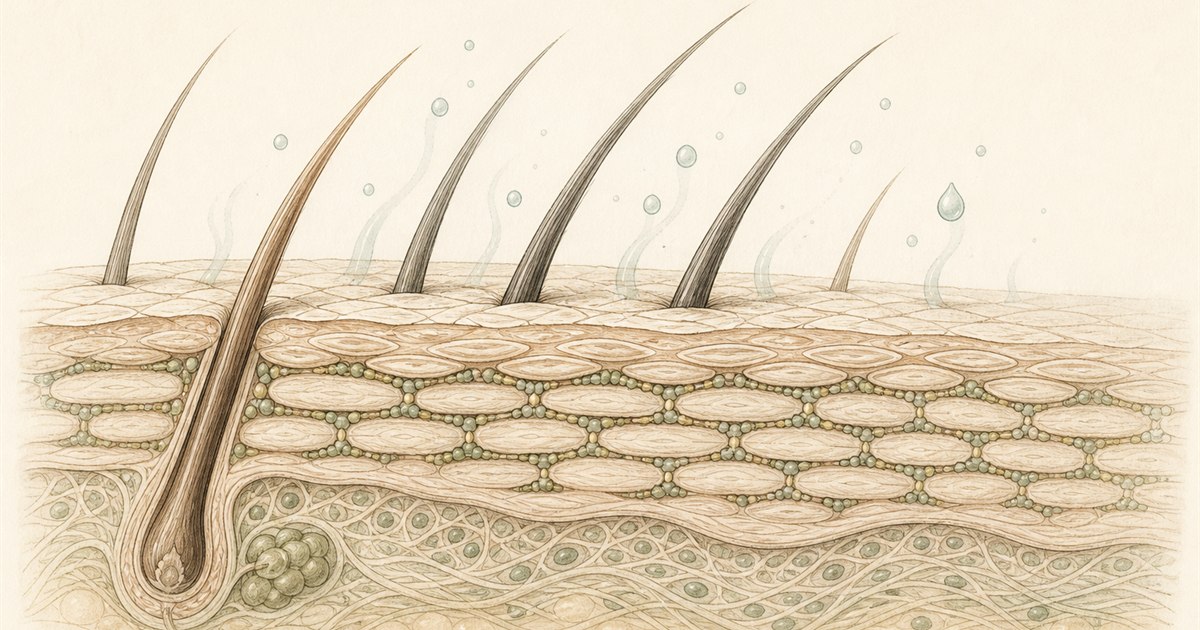
The barrier holds water in and keeps irritants out through an organised lipid matrix — ceramides, cholesterol and free fatty acids. In one small study, dogs with atopic dermatitis lost more water through their skin and ceramides made up a smaller share of their skin lipids than in healthy dogs. These findings describe differences between groups; they do not establish how a grooming product will perform.
Compared with healthy dogs, the dogs with atopic dermatitis had higher water loss and a lower share of ceramides in both visibly affected and normal-looking skin. That does not mean every dog needs the same routine. If your dog has atopic skin, discuss how everyday skin care fits the plan agreed with your veterinarian.
Ingredients mentioned in this section
Skin pH is not one fixed number
Canine skin surface pH varies with age and body site. In the cited study of 77 healthy dogs, researchers measured intact skin at the ears, armpits and groin. The study did not test shampoos or identify an ideal pH for a grooming product.
When choosing a grooming product, check that it is intended for dogs and follow its directions. A pH figure alone does not establish suitability, and a product intended for human skin is not a substitute for a dog-specific product or veterinary advice. The complete formula and how it is used matter too.
More about the research
Ingredients mentioned in this section
A thin outer layer under a dense coat
The stratum corneum — the outermost layer of the epidermis — has been measured in dogs at a mean of about 47 cell layers and 13 micrometres, over a living epidermis of three to six cell layers. The same measurements found it similar on the back and abdomen but thicker in the inguinal fold, so the outer layer is not one number even within a single dog. It also sits under a dense coat rather than in open air.
These measurements describe canine skin structure. They do not compare dog and human skin layer for layer or show how a particular shampoo will behave. A product's suitability cannot be decided from an anatomy diagram or from how it feels on a person's arm.
Sources and limitations
Sources for this guide
Each note explains what its source supports. Dog studies describe only the dogs and measurements studied, not product benefits. Sources on human cosmetics explain terminology and formulation; they are not pet-product law, canine approval or proof about a finished shampoo.
Source 1
Lloyd et al. — epidermal structure and surface topography of canine skinMeasurements of canine skin, including differences in outer-layer thickness by body site. The study measured dogs only, made no human-skin comparison and did not assess grooming products or the meaning of a change in an individual dog.
Source 2
Shimada et al. — transepidermal water loss and ceramides in canine atopic dermatitisTen dogs with atopic dermatitis and thirty healthy controls, reporting raised water loss and lower ceramide content in both lesional and normal-looking skin. It is not evidence that a grooming product corrects either.
Source 3
Schlake et al. — physiological factors and canine skin pHA prospective study of 77 healthy dogs showing skin-pH variation by age and body site. It sets no ideal pH for a dog or shampoo and supports no claim here about breed or season.
Explore Cori’s care concepts, currently in development.
About Cori skin care