Transparency
Dog shampoo ingredients: what are they for?
Some ingredients help clean, others affect texture, scent or product protection. This guide explains those possible roles using a fictional label. For a shorter starting point, use the label-reading guide linked below.
On this page
One fictional dog-shampoo label, mapped by function
The illustration uses twelve familiar names as a teaching device: Aqua, Sodium Laureth Sulfate, Cocamidopropyl Betaine, Decyl Glucoside, Glycerin, Guar Hydroxypropyltrimonium Chloride, Xanthan Gum, Disodium EDTA, Sodium Benzoate, Citric Acid, Parfum and Linalool.
This is not a real product, complete formula, manufacturing specification, recommendation or do-it-yourself recipe. The sequence is not presented as a legally required order and does not disclose concentrations. The visual groups possible roles without ranking the ingredients; the ingredient-function glossary provides the underlying terminology and limitations for each name.
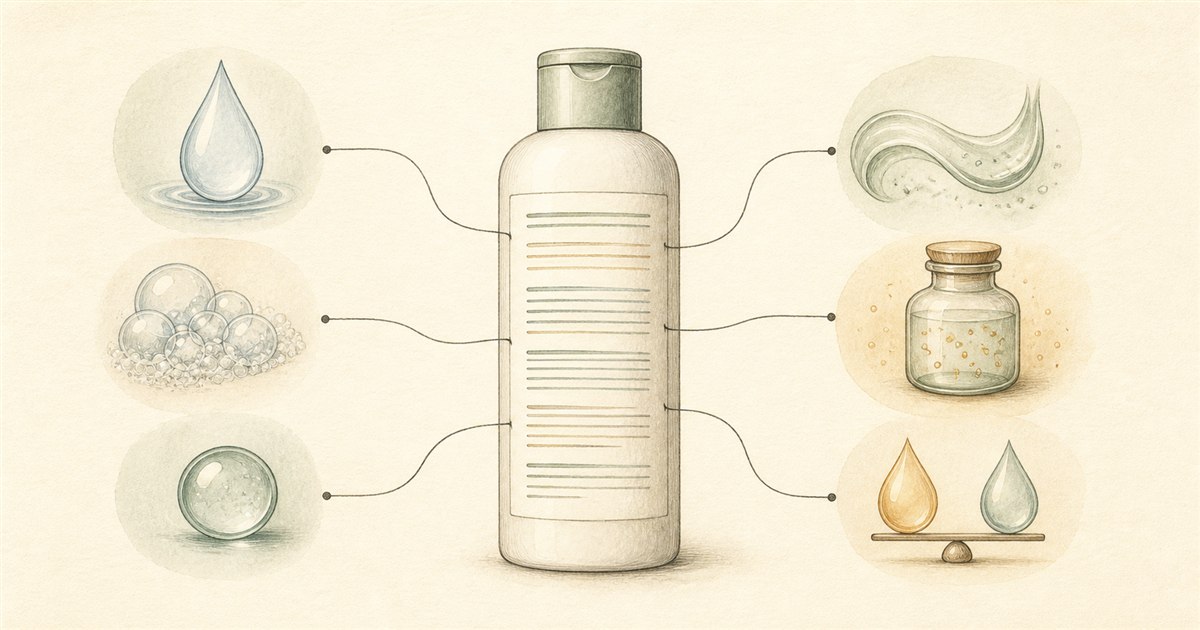
Reported functions are possible roles, not proof of finished-product performance, mildness or canine safety. The complete product and its stated conditions of use remain the relevant unit of assessment.
The cleansing system works as a blend
Sodium Laureth Sulfate, Cocamidopropyl Betaine and Decyl Glucoside all have reported cleansing or surfactant functions in human-cosmetics terminology. On a shampoo label, their presence can suggest that the formulator built a mixed cleansing system rather than relying on one surface-active material.
The names do not reveal the amount of active surfactant, the ratio between materials, raw-material composition, cleansing strength, mildness or finished-product tolerance. Those properties depend on the complete formulation and use conditions. It is therefore more useful to ask how the finished shampoo was evaluated than to rank the three names in isolation.
More about the research
Ingredients mentioned in this section
Water and a moisture-related role
Aqua commonly identifies the liquid carrier. Glycerin has reported humectant, skin-conditioning and solvent functions. Together, those names can suggest a water-based system with a moisture-management component, but they do not establish how much glycerin is present or what remains after rinsing.
A humectant appearing on a rinse-off label is not proof that the finished shampoo moisturises canine skin. Formula design, contact time, rinsing and evidence from the finished product are still missing from the list. This is one reason rinse-off and leave-on products create different exposure questions.
Ingredients mentioned in this section
Conditioning, thickness and controlled flow
Guar Hydroxypropyltrimonium Chloride has reported antistatic, film-forming, conditioning and viscosity-control functions. Xanthan Gum has reported binding, gel-forming, emulsion-stabilising and viscosity-control functions. A formulator may use them to shape deposition, texture or dispensing as part of a larger system.
Their presence does not prove easier combing, a particular viscosity, physical stability or a coat result. Supplier grade, amount, processing and interactions with the surfactant system are not visible on the label.
Ingredients mentioned in this section
Preservation, chelation and pH are systems
Disodium EDTA has a reported chelating role, Sodium Benzoate a preservative role, and Citric Acid buffering and chelating roles. These supporting ingredients may help a formulator manage metal ions, product protection or pH, but the list does not show whether each name is serving that purpose in this formula.
One named preservative does not establish that the complete product is adequately protected through manufacture, storage and intended use. Likewise, one acid does not disclose the finished pH. ISO 11930 describes finished-formulation evaluation for antimicrobial protection in cosmetics; Cori uses it only to illustrate why product protection is assessed as a system, not as canine-specific approval.
More about the research
Ingredients mentioned in this section
Why Parfum and Linalool can both appear
Parfum is a deliberately broad ingredient term for a material or blend used to create or mask odour. Linalool has reported perfuming and deodorant functions and may be listed as a separate scent material or as a disclosed component under an applicable labelling framework.
Seeing both names does not reveal their source, concentration, scent intensity, persistence, tolerability or the disclosure duty that applied to this product. Human-cosmetics terminology can help identify the words, but it should not be presented as pet-product legal advice or a canine safety verdict.
More about the research
Ingredients mentioned in this section
Five useful questions for the manufacturer
A label becomes more useful when it leads to specific questions that can be answered with information about the finished product.
- What are the exact dilution, contact-time and rinsing directions for this format?
- Is a finished-product pH range available, and how is it measured and controlled?
- How was product protection evaluated for the complete formula, packaging and intended use?
- What finished-product evidence supports each specific claim about performance or tolerance?
- What use limits, stop-use instructions and escalation advice accompany the product?
More about the research
What the ingredient list cannot tell you
The list cannot disclose exact percentages, supplier grades, impurity profiles, processing conditions, finished pH, preservation-test results, shelf life, cleansing strength, tolerance or suitability for an individual dog. A 2022 study of twenty commercial nonmedicated dog shampoos found materially different measured pH and viscosity values, which illustrates why finished properties have to be measured rather than inferred from a familiar name.
Canine skin does not have one universal pH either: a prospective study of healthy dogs reported variation with age and anatomical location. Neither finding supplies a target for choosing a shampoo. Both reinforce the narrower point that one label name or one headline number cannot stand in for product-specific evidence.
When label reading should stop
Increased or severe itch, fur loss, injuries, pain or another unexpected skin or coat change needs veterinary assessment. Comparing ingredients cannot identify the cause.
If you noticed a change after using a product, keep its label and directions, note what happened and when, and contact your veterinarian. This article does not identify a cause or recommend treatment.
Read the label alongside the directions
Before interpreting individual names, identify the product format, directions, intended use, market and legal classification. A rinse-off shampoo used as supplied is not the same exposure as a concentrate that must be diluted, and neither should be read like a leave-on spray. Contact time, rinse instructions and packaging belong to the product story even though they are not ingredients.
The familiar EU human-cosmetics ingredient-order rule does not automatically govern a dog-grooming product simply because its label uses similar names. Our guide on how to read a canine grooming ingredient list explains how to establish the applicable convention before drawing conclusions from position.
Sources and limitations
Sources for this guide
Each note explains what its source supports. Dog studies describe only the dogs and measurements studied, not product benefits. Sources on human cosmetics explain terminology and formulation; they are not pet-product law, canine approval or proof about a finished shampoo.
Source 1
European Commission — CosIng cosmetic ingredient databaseNon-binding human-cosmetics terminology source for ingredient names and reported functions; it is not canine approval or a finished-product assessment.
Source 2
Regulation (EC) No 1223/2009 on cosmetic productsHuman-cosmetics context for ingredient labelling and safety-assessment information. It is not applied here as pet-grooming law.
Source 3
Commission Implementing Decision (EU) 2025/1175Current glossary of common ingredient names for EU cosmetic-product labelling, applicable from 30 July 2026; used only for terminology context.
Source 4
ISO 11930:2019 — evaluation of antimicrobial protectionA human-cosmetics finished-formulation standard used here only to explain why spotting one preservative name does not validate a complete product-protection system.
Source 5
Peña-Corona et al. — characteristics of commercial nonmedicated dog shampoosA 2022 study of twenty nonmedicated dog shampoos sold in Mexico City, reporting differences in measured pH and viscosity. These findings describe that sample; they are not a universal specification, quality threshold or product recommendation.
Source 6
Schlake et al. — physiological factors and canine skin pHA prospective study of 77 healthy dogs showing skin-pH variation by age and body site. It sets no ideal pH for a dog or shampoo and supports no claim here about breed or season.
Source 7
WSAVA — Principles of Wellness: DermatologyGeneral veterinary guidance on individual skin and coat care and assessment of abnormalities or increased or severe itch. It identifies no cause, recommends no treatment for an individual animal and sets no universal bathing interval.
Source 8
UK Veterinary Medicines Directorate — non-medicinal veterinary product advertisingUK-specific claims boundary used conservatively to keep diagnosis, treatment, prevention and implied medicinal effects outside this educational article.
Explore Cori’s care concepts, currently in development.
About Cori skin care